

Where autonomy broke down
Our experience convinced us that engineering agents cannot operate entirely on their own. Neither loops nor graphs solved that problem.
When we built our R&D organization from scratch in mid-2026, we committed heavily to autonomous work. At our highest point, agents handled 98% of tickets without an engineer participating. The early excitement gave way to serious problems:
- Getting pull requests merged became a struggle with CI and automated reviewers.
- Agents delivered too much or too little, drifted outside the intended scope, and seldom completed the actual job we needed.
- The repository became overly complex and unmaintainable. Engineers and agents alike lost familiarity with the code.
Why we built Exponent
We built Exponent as our internal orchestration system to protect quality and keep work aligned while retaining speed.
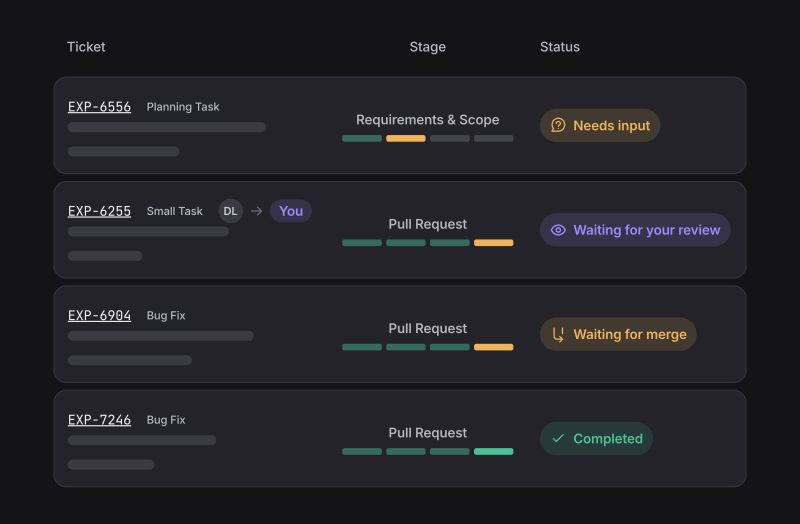
Agents still work autonomously, but they can call on people at predefined checkpoints throughout development. Human involvement extends beyond the initial request and the final pull request.
How it works
- A queue for attention. Work runs in the background. A task moves to the top when an agent needs an engineer.
- Visibility across the team. The Everyone view exposes prompts and decisions throughout a ticket, letting engineers collaborate with more context than the resulting code alone.
- Specialists for each development step. Dedicated agents follow a strict structure, with separate contexts and stage-specific artifacts. This keeps scope and intent intact and helps engineers avoid excessive reliance on agents.
- Checkpoints suited to the work. Feature planning, bugs, and UI tasks follow different workflows with their own human gates.
- End-to-end coordination. The orchestrator moves each task through the development lifecycle and also sends progress updates to Slack.
I’ll share more details about how Exponent works over the coming weeks.
Originally shared on LinkedIn.
← Back to all articles