

The hardware constraint
We set out to find an open-weights model that could understand Hebrew and generate tokens at a practical speed on a CPU-only server with just 32 GB of memory.
Where Qwen 2.5 fell short
We started with Qwen 2.5. In our tests, explicit instructions to stay in Hebrew still led to Chinese after only a sentence or two. Blocking CJK tokens removed the Chinese, but the model then produced French, Turkish, and emojis instead.
What we measured
We moved on to Qwen 3.x and added Gemma 4, Nemotron, Ministral, and gpt-oss to the comparison. We measured time to first token and tokens per second alongside Hebrew performance.
Our Hebrew evaluation covered six tasks:
- HeQ: extract a brief answer from a Hebrew paragraph, or recognize that the paragraph does not contain one.
- Belebele: choose the correct answer after reading a passage in Hebrew.
- Global-MMLU: answer exam-style questions in Hebrew without a supporting passage.
- FLORES+ EN → HE: translate individual English sentences into Hebrew.
- FLORES+ HE → EN: translate individual Hebrew sentences into English.
- HeSum: condense a Hebrew article into several Hebrew sentences.
The best fit for the hardware
Qwen 3.6 (35B-A3B) gave us the best fit within the 32 GB, CPU-only constraint. Its mixture-of-experts architecture activates approximately 3 billion parameters per token, and it performed well without a GPU.
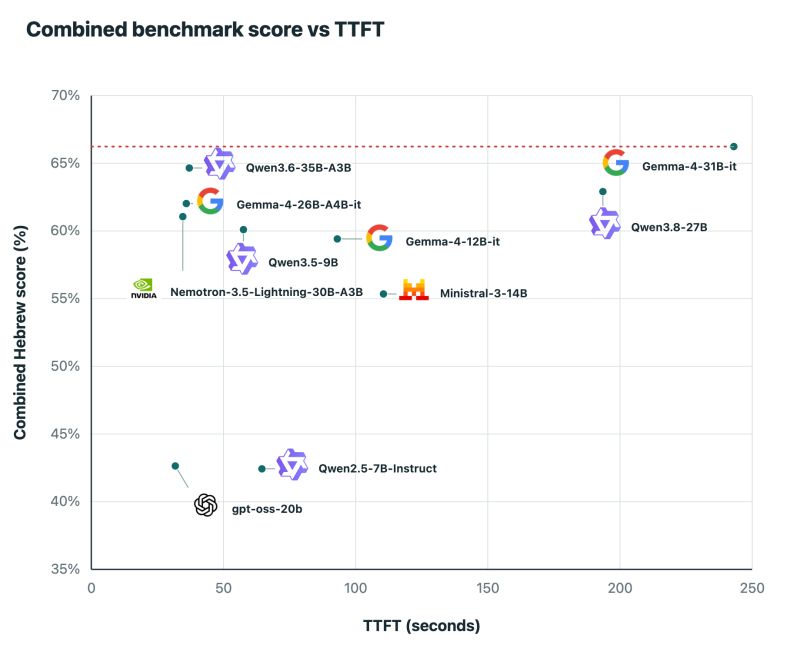
We’re hoping for stronger hardware when it’s time for the full deployment.
Originally shared on LinkedIn.
← Back to all articles